

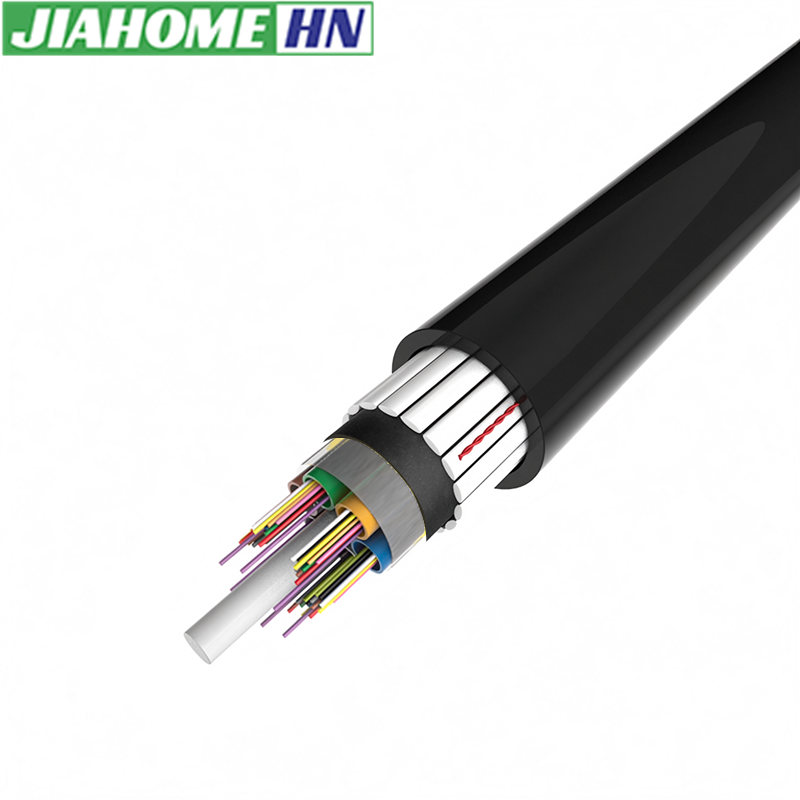
Anti-rodent Fiber Optic Cable
Specification
ADSS Anti-Rodent Optical Cable is an All-Dielectric Self-Supporting (ADSS) fiber optic cable designed with additional protective structures to reduce the risk of damage caused by rodents such as rats and squirrels. Unlike conventional ADSS cables, which mainly use a standard outer sheath for environmental protection, anti-rodent ADSS cables incorporate enhanced physical protection, such as special protective layers, reinforced sheath materials, or other rodent-resistant designs. These cables are widely used in overhead telecommunications networks, power transmission corridors, rural broadband projects, and areas where rodents may damage exposed optical cables.
| Jiahome Fiber Optic Specification | ||
| Fiber Type | Singlemode G.652.D | |
| Liner diameter | 125.0±1.0μm | |
| Cladding-core concentricity | ≤0.6μm | |
| Non-circularity of the coating | ≤ 1.0% | |
| Coating diameter | 250 ± 15 μm (Before color) | |
| Coating-coating concentricity | 12μm | |
| Attenuation | ||
| Wavelength (nm) | Maximum values (dB/km) | |
| 1310 | 0.36 | |
| 1550 | 0.22 | |
| Dispersion | ||
| Zero Dispersion Wavelength | 1300~1324nm | |
| Zero Dispersion Slope | ≤0.092 ps/(nm^2·km) | |
| Mode Field Diameter (MFD) | ||
| 1310nm | 8.7~9.5μm | |
| 1550nm | 10.4±0.5μm | |
| Polarization mode dispersion (PMD) | ||
| Link layout value | ≤ 0.1 ps/√km | |
| Cut wavelength | ||
| λcc | ≤1260nm | |
| Macro-curvature-induced attenuation | ||
| 100 turns around a 60 mm radius chuck | 1550nm | ≤0.05dB |
| 100 turns around a 60 mm radius chuck | 1625nm | ≤0.05dB |
| Standards | ||
| ITU G652.D | IEC 60793-2-50 type B1.3 | |

Application
1. Forest and Woodland Areas
Forested transmission corridors often have high squirrel and rodent activity.
Anti-rodent ADSS cable provides additional protection for aerial fiber networks installed along these routes.
2. Rural Broadband Networks
In rural areas, optical cables are frequently installed on existing utility poles.
Rodent-resistant cable can help protect communication infrastructure where maintenance access is difficult or cable damage is frequent.
3. Power Transmission Corridors
ADSS cables are commonly installed along power transmission routes for communication between substations and control centers.
Anti-rodent protection is useful in transmission corridors surrounded by vegetation or forest.
4. Tropical and High-Humidity Regions
In tropical regions, dense vegetation and high biological activity may increase the risk of animal-related cable damage.
A suitable anti-rodent ADSS design can provide additional protection for outdoor fiber networks in these environments.
HOT-SALE PRODUCT
Outdoor optical cable, indoor optical cable, indoor armored optical cable, air-blown optical cable, OPGW, optical jumper, etc.

