
Jiahome OPGW is Ready for Shipment | 500kV Transmission Project in Central Asia
Another batch of transmission-line OPGW48 G.652 is ready for delivery to a 500kV power transmission project in Central Asia.
This shipment includes:
1. OPGW48 G.652
2. Tension Clamps
3. Suspension Clamps
4. Joint Boxes
5. Related OPGW installation accessories
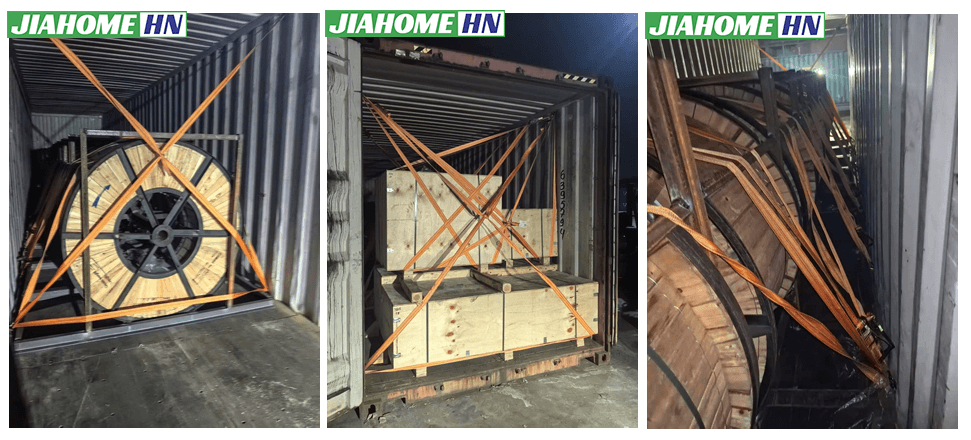
From optical fiber cable supply to matching line hardware, reliable compatibility between components is essential for efficient OPGW installation and long-term transmission-line operation. The equipment has now been loaded and is ready for shipment to the project site.
For EPC contractors, utilities and power-line distributors, we – Hunan Jiahome (Optical Fiber Cable & Hardware Manufacturer)provide OPGW and matching installation fittings for high-voltage and extra-high-voltage transmission projects.
1. 500kV Project | Central Asia
2. OPGW 48G.652 | Complete Installation Fittings
1.What Is OPGW and Why Is It Used on 500kV Transmission Lines?
OPGW, or Optical Ground Wire, combines the functions of an overhead grounding conductor and an optical fiber communication cable in a single transmission-line component.
OPGW is normally installed at the top of transmission towers.
It serves two primary functions:
Lightning protection and grounding
Optical communication for power-grid operation
This dual function makes OPGW particularly valuable for modern transmission networks.
In a 500kV transmission line, the power system requires reliable communication for applications such as:
1. Substation communication
2. Protection signaling
3. SCADA systems
4. Power-grid monitoring
5. Fault detection
6. Remote control
7. Data transmission
Instead of installing a separate optical cable and a conventional overhead ground wire, OPGW integrates both functions into one cable structure. For long-distance transmission projects, this can simplify the overall line design while providing a dedicated optical communication path.
2.What Are the Main Components of an OPGW Installation System?
A typical OPGW installation system includes the OPGW cable itself plus mechanical and optical accessories such as tension clamps, suspension clamps and joint boxes.
A complete OPGW installation may include:
OPGW Cable
The main optical ground wire carries both the grounding function and optical communication fibers.
OPGW Tension Clamp
A tension clamp, also called a dead-end or termination clamp in some applications, is used where the OPGW must withstand the mechanical tension at a termination or tension tower.
OPGW Suspension Clamp
A suspension clamp supports the OPGW at suspension towers while maintaining the required mechanical and installation geometry.
OPGW Joint Box
The joint box, or fiber optic splice enclosure, provides a protected location for optical fiber splicing and connection between OPGW sections.
Related Accessories:
Grounding accessories
Down-lead clamps
Vibration dampers
Protective rods
Storage assemblies
Connection hardware
Installation tools
3.How Should OPGW and Fittings Be Selected for a 500kV Project?
OPGW selection should consider optical requirements, mechanical loading, environmental conditions and tower configuration together rather than focusing on fiber count alone.
For a 500kV transmission project, procurement teams may need to review the following parameters.
1. Optical Fiber Count
The required fiber count depends on the project’s communication, protection and network requirements.
A 48-fiber configuration can provide substantial communication capacity for complex power-grid applications.
2. Fiber Type: The project specification should clearly identify the required fiber type, such as G.652 or G.652D where applicable.
3. OPGW Diameter
The cable diameter directly affects the selection of compatible:
Suspension clamps
Tension clamps
Protective fittings
Vibration dampers
4. Rated Tensile Strength
The OPGW must be capable of handling the mechanical loads associated with the transmission line.
This is particularly important for:
Long spans
Mountainous terrain
High wind areas
Large tower spans
Heavy icing conditions
5. Short-Circuit Current Requirement: Because OPGW also serves as a grounding wire, its electrical characteristics must satisfy the project’s fault-current requirements.
6. Sag and Tension: The OPGW installation design should be coordinated with the transmission-line mechanical design to achieve the required sag and tension.
7. Environmental Conditions
Project conditions can include:
Wind
Temperature variation
Ice
Corrosion
Altitude
Pollution
Lightning exposure
These factors can affect both OPGW selection and fitting design.
4.OPGW Installation Considerations for Central Asian Transmission Projects
Central Asian transmission projects can involve long distances, large temperature variations, strong winds, remote terrain and demanding logistics, making appropriate OPGW design and installation planning important.
Central Asia contains extensive transmission infrastructure and large-scale power-grid development projects. Depending on the project location, OPGW systems may need to operate under challenging environmental conditions.
Potential considerations include:
Temperature Variation: Large daily and seasonal temperature changes can affect cable tension and sag.
Wind: Strong wind can create additional mechanical loading and vibration.
Remote Project Locations: Long-distance transmission lines may pass through areas far from major transportation infrastructure.
Installation Logistics: OPGW cable drums and fittings must be delivered to tower construction areas while protecting the cable and associated hardware.
Maintenance: Long-term accessibility should also be considered when designing joint locations and selecting accessories.
For international EPC contractors, these factors should be incorporated into the technical specification before procurement begins.
5.Why Choose a Complete OPGW and Fittings Supply Solution?
For a high-voltage transmission project, successful OPGW installation depends on more than the optical cable itself.
The cable, clamps, joint boxes and related accessories need to work together as a coordinated system.
For international EPC contractors and utilities, a complete supply solution can provide advantages in:
Technical coordination
Product compatibility
Procurement efficiency
Installation preparation
Quality documentation
Shipment management
Project communication
For a 500kV transmission project, these factors become particularly important because the transmission route can extend over long distances and involve large quantities of equipment and accessories.
6.Frequently Asked Questions
1. What does 48-fiber OPGW mean?
48-fiber OPGW means that the optical ground wire contains 48 optical fibers inside its cable structure.
2. Is G.652 the same as G.652D?
No. G.652 is a broader ITU-T optical fiber recommendation, while G.652D is a specific category within the G.652 family. The exact fiber type should follow the project’s technical specification.
3. What is an OPGW tension clamp?
An OPGW tension clamp is a fitting used to secure the OPGW at tension or termination locations and withstand the required mechanical load.
4. What is an OPGW suspension clamp?
An OPGW suspension clamp supports the optical ground wire at suspension towers while maintaining the required installation position and mechanical condition.
5. What is an OPGW joint box?
An OPGW joint box protects optical fiber splices and provides an enclosure for connecting OPGW cable sections.
6. What factors determine OPGW selection?
Important factors include fiber count, fiber type, cable diameter, rated tensile strength, short-circuit current capacity, span length, environmental conditions and tower configuration.
7. Can OPGW fittings be customized?
Yes. OPGW fittings can be selected or designed according to cable diameter, mechanical requirements, tower configuration and project specifications.
8. Why should OPGW fittings match the cable?
The fittings must be mechanically and dimensionally compatible with the OPGW. Incorrect matching can create installation difficulties or affect long-term mechanical performance.
Post time: Oct-28-2026