
GPON vs EPON: What Is GPON & EPON Technology?
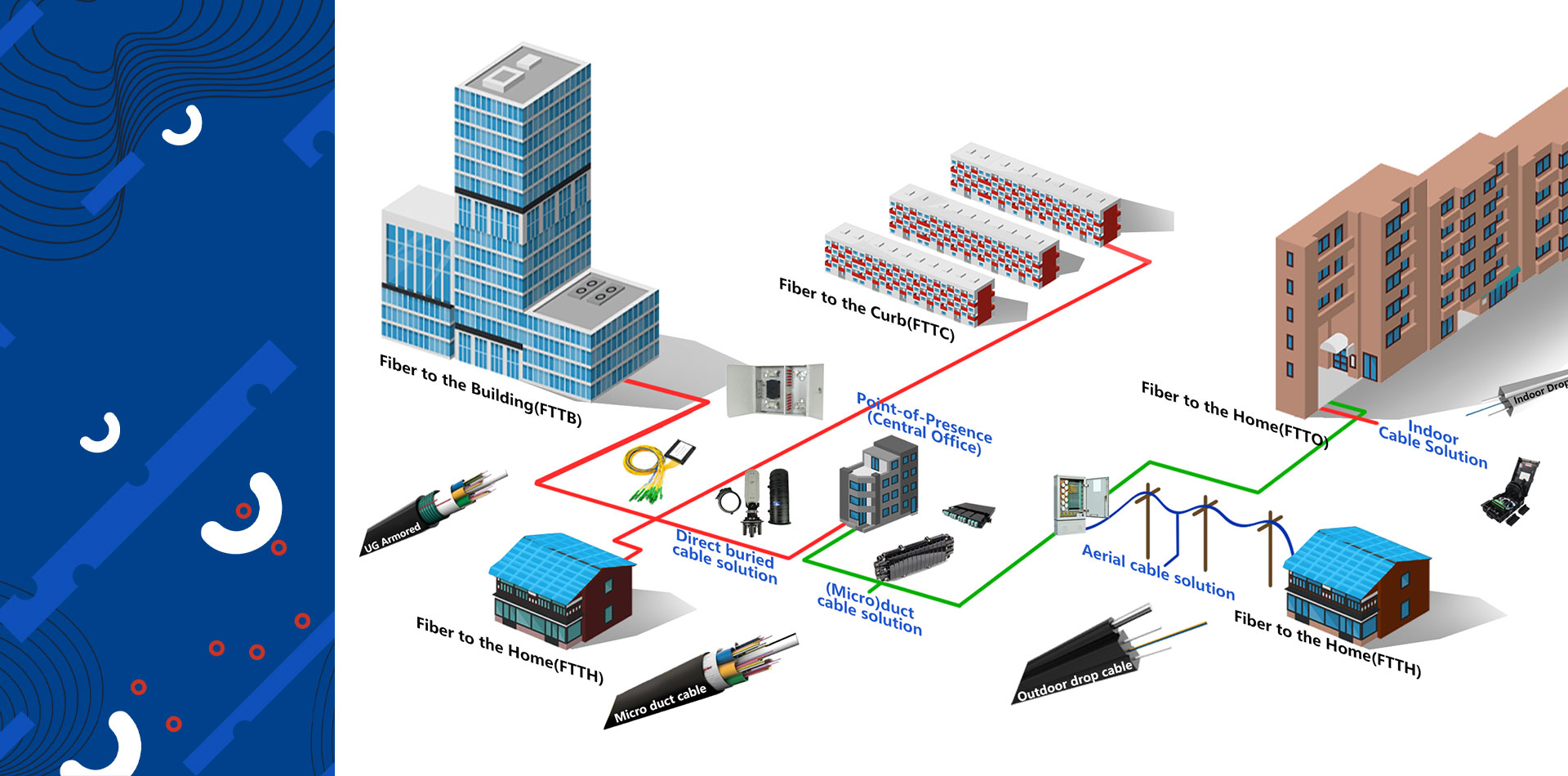
Gigabit Passive Optical Network (GPON) and Ethernet Passive Optical Network (EPON) are the two most widely deployed PON technologies used in modern fiber access networks. Both enable high-speed broadband, voice, and video services over a passive fiber infrastructure, yet they differ significantly in standards, performance, compatibility, and application scenarios.
What Is PON (Passive Optical Network)?
PON is a point-to-multipoint fiber access technology that uses passive splitters to deliver services without active components in the field.
A Passive Optical Network consists of:
-
OLT (Optical Line Terminal) at the central office
-
Optical splitters in the distribution network
-
ONU/ONT (Optical Network Unit/Terminal) at the user side
PON technology reduces power consumption, lowers maintenance costs, and enables scalable FTTH, FTTB, and FTTC networks. GPON and EPON are the most common PON standards used today.
What Is GPON Technology?
GPON is an ITU-T standardized PON technology offering higher bandwidth and stronger QoS capabilities.
GPON (Gigabit Passive Optical Network) is defined by ITU-T G.984/G.988 standards. It provides asymmetric high-speed data transmission suitable for triple-play and multi-service networks.
Key features of GPON:
-
Downstream rate: 2.5 Gbps
-
Upstream rate: 1.25 Gbps
-
Maximum split ratio: 1:64 or 1:128
-
Strong QoS and traffic management
-
Widely adopted by telecom operators and national broadband projects
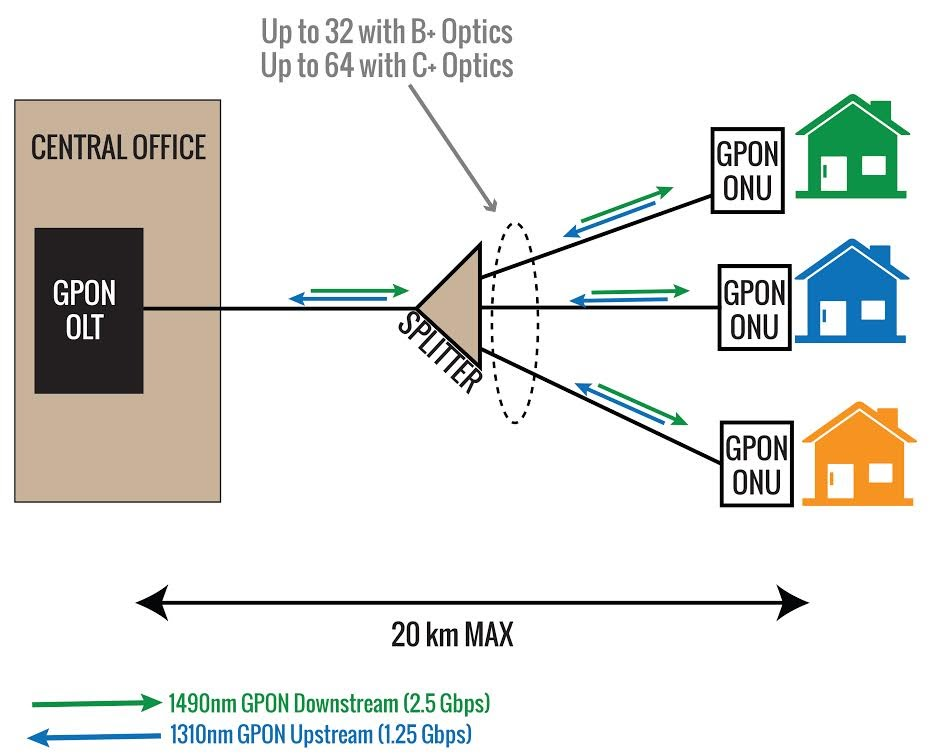
GPON technology is ideal for large-scale FTTH deployments, especially where guaranteed bandwidth and service quality are critical. Hunan Jiahome supplies GPON-compatible optical fiber cables, drop cables, and passive components designed for long-term network reliability.
What Is EPON Technology?
EPON is an IEEE-based PON technology built on Ethernet protocols for cost-effective deployments.
EPON (Ethernet Passive Optical Network) follows IEEE 802.3ah / 802.3av standards and uses native Ethernet frames for data transmission.
Key features of EPON:
-
Downstream rate: 1.25 Gbps
-
Upstream rate: 1.25 Gbps
-
Maximum split ratio: 1:64
-
Simple architecture and lower equipment cost
-
Strong compatibility with Ethernet networks
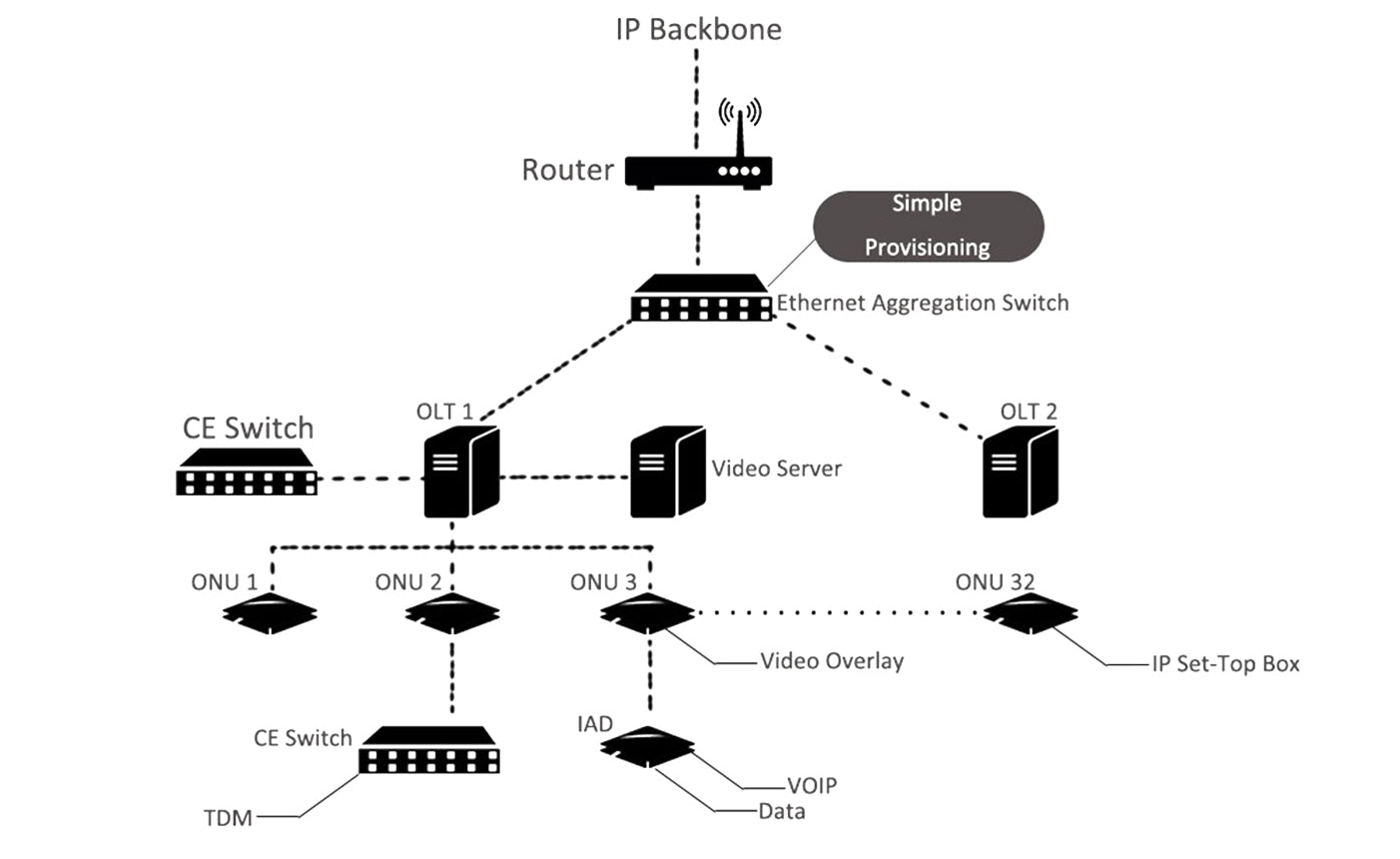
EPON Technology
EPON is widely used in Asia-Pacific markets, enterprise networks, and cost-sensitive FTTH/FTTB projects. Fiber solutions from Hunan Jiahome are fully compatible with EPON infrastructure requirements.
GPON vs EPON: Key Differences
GPON focuses on performance and QoS, while EPON emphasizes simplicity and Ethernet compatibility.
| Feature | GPON | EPON |
|---|---|---|
| Standard | ITU-T | IEEE |
| Downstream Speed | 2.5 Gbps | 1.25 Gbps |
| Upstream Speed | 1.25 Gbps | 1.25 Gbps |
| Protocol | GEM frames | Ethernet frames |
| QoS Capability | Very strong | Moderate |
| Typical Use | Telecom operators, large FTTH | ISPs, enterprises, cost-effective FTTH |
| Equipment Cost | Higher | Lower |
Which Is Better: GPON or EPON?
The best choice depends on network scale, service type, and budget.
Choose GPON if:
-
You need higher downstream bandwidth
-
You operate a carrier-grade network
-
QoS and multi-service support are priorities
Choose EPON if:
-
You prefer Ethernet-based architecture
-
Budget control is important
-
The network scale is medium or small
In practice, many operators deploy both GPON and EPON in different scenarios. Hunan Jiahome supports customized fiber solutions for hybrid PON networks.
Applications of GPON and EPON Networks
Both technologies are widely used in broadband access and fiber distribution networks.
Common applications include:
-
FTTH (Fiber to the Home)
-
FTTB (Fiber to the Building)
-
FTTC (Fiber to the Curb)
-
Smart city infrastructure
-
Industrial and campus networks
High-quality optical cables, drop cables, and passive accessories supplied by Hunan Jiahome ensure stable performance in both GPON and EPON systems.
Future Development: GPON, EPON, and Beyond
GPON and EPON continue to evolve toward higher bandwidth standards.
Upgraded technologies include:
-
XG-PON / XGS-PON
-
10G-EPON
-
50G-PON (next-generation PON)
While next-generation PON is growing, GPON and EPON remain the mainstream solutions for current FTTH deployments worldwide.
FAQ: GPON vs EPON Technology
Q1: Can GPON and EPON work on the same fiber network?
Yes, they can share the same fiber infrastructure but require different OLT and ONU equipment.
Q2: Is GPON faster than EPON?
Yes, GPON offers higher downstream bandwidth (2.5 Gbps vs 1.25 Gbps).
Q3: Which technology is cheaper, GPON or EPON?
EPON equipment is generally more cost-effective, making it suitable for budget-sensitive projects.
Q4: Does Hunan Jiahome support both GPON and EPON networks?
Yes. Hunan Jiahome manufactures and exports optical fiber cables and FTTH solutions compatible with both GPON and EPON systems.
Q5: Is EPON outdated compared to GPON?
No. EPON is still widely used and continues to evolve with 10G-EPON standards.
Post time: Dec-25-2025