
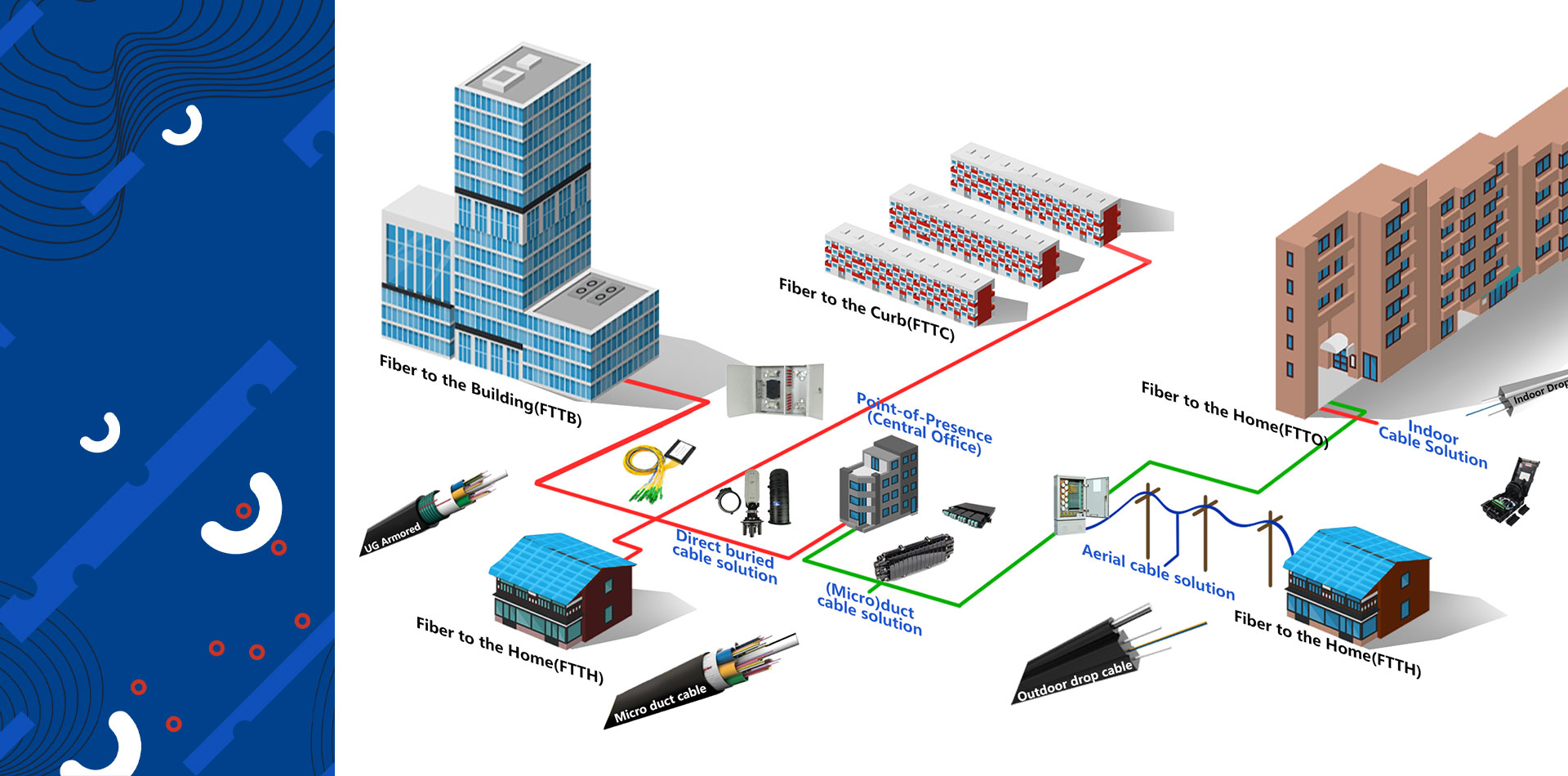
G657A1 fiber is a bend-insensitive single-mode optical fiber designed to maintain reliable optical performance when installed with relatively small bending radii. It is particularly valuable in FTTH, FTTx, indoor access networks, high-density fiber distribution systems, and other installations where space is limited. Compared with conventional G652D fiber, G657A1 provides improved macrobending performance while remaining compatible with the G652D fiber family.
For international buyers, EPC contractors, telecom operators, and system integrators, however, specifying G657A1 alone is not enough—the final fiber optic cable must also meet the required optical, mechanical, environmental, testing, and installation requirements.
The current ITU-T G.657 Recommendation, approved in August 2024, defines characteristics for bending-loss insensitive single-mode optical fibre and cable. The current recommendation states that Category A fibers are fully compliant with G.652 single-mode fibers and can be deployed in access, general transport, and other space-constrained networks. Specifically, G.657.A1 is associated with a minimum design radius of 10 mm, while G.657.A2 is designed for a smaller 7.5 mm minimum design radius.
For our buyers, this distinction is important: G657A1 describes the fiber’s optical characteristics; the performance of the finished G657A1 fiber optic cable depends on its complete cable construction and applicable cable standards.
What Is G657A1 Fiber?
G657A1 is a Category A bend-insensitive single-mode optical fiber specified by ITU-T Recommendation G.657. It provides improved resistance to macrobending loss compared with conventional G652 fiber and is suitable for applications where optical fibers must be routed through relatively tight spaces.
G657A1 was developed primarily to address the installation challenges associated with modern access networks. FTTH and FTTx deployments often contain dense distribution points, compact cabinets, wall outlets, indoor routing paths, and numerous fiber manipulations. These environments can introduce bending that would produce greater optical loss in conventional fibers.
The current ITU-T G.657 recommendation explains that the Category A fibers are optimized for reduced macrobending loss compared with G652.D and remain compliant with G652.D characteristics. They can therefore be used not only in access networks but also in transport and data-center environments where bend-optimized cabling is beneficial.
What Does “G657A1″ Mean?
The designation can be understood as:
G — ITU-T G-series recommendation
657 — the recommendation covering bending-loss insensitive single-mode optical fiber and cable
A — Category A
1 — A1 subcategory
The “A” category is particularly important because it distinguishes G657A1 from Category B fibers.
According to the current ITU-T recommendation, Category A fibers are fully compliant with G652 single-mode fibers, while Category B fibers are optimized for even smaller bending radii and are primarily intended for shorter-reach applications near the end of access networks.
G657A1 Fiber Technical Specifications
When evaluating G657A1, we should look beyond the product name and review parameters such as mode field diameter, cladding diameter, attenuation, chromatic dispersion, cut-off wavelength, polarization mode dispersion, and macrobending performance.
The current ITU-T G.657 recommendation covers fiber attributes including:
- Mode field diameter
- Cladding diameter
- Core concentricity error
- Cladding non-circularity
- Cut-off wavelength
- Macrobending loss
- Material properties
- Refractive index profile
- Chromatic dispersion
- Cable attenuation
- Polarization mode dispersion
These parameters are explicitly included in the current recommendation.
Why Is G657A1 Bend-Insensitive?
G657A1 is called bend-insensitive because its fiber design significantly reduces macrobending loss compared with conventional single-mode fibers. This allows the fiber to maintain acceptable optical performance when routed around tighter bends.
When an optical fiber is bent, part of the guided optical power can escape from the core-cladding structure. This produces additional attenuation known as bending loss.
There are two important forms of bending-related loss:
Macrobending
Macrobending occurs when the fiber is bent around a relatively large, visible radius—for example:
- Routing around a corner
- Coiling excess fiber
- Routing inside an FTTH box
- Installing fiber inside a wall outlet
- Managing fiber inside a distribution cabinet
Microbending
Microbending refers to small-scale irregularities or pressure points along the fiber that can also increase attenuation.
G657A1 is primarily recognized for its improved macrobending performance.
The ITU-T G.657 recommendation specifically describes the family as having improved bending-loss performance compared with G652 fibers.
For network operators, the practical advantage is straightforward:
A fiber that tolerates tighter routing can reduce installation constraints and help maintain optical performance in high-density environments.
G657A1 Minimum Bend Radius
Under the current ITU-T G.657 recommendation, G657A1 is appropriate for a minimum design radius of 10 mm, while G657A2 is designed for a smaller 7.5 mm minimum design radius.
This is one of the most important specifications when comparing G657A1 and G657A2.
| Fiber Minimum | Design Radius |
| G657A1 | 10 mm |
| G657A2 | 7.5 mm |
G657A1 vs G652D
G657A1 and G652D are both single-mode fiber specifications, but G657A1 is optimized for significantly better bending performance. Importantly, current ITU-T G.657 Category A fibers are compliant with G652 characteristics, making G657A1 suitable for networks where G652D compatibility is important.
| Feature | G652D | G657A1 |
| Fiber Type | Single-mode | Bend-insensitive single-mode |
| Bend Performance | Standard | Improved |
| Small-radius Installation | More restrictive | Better suited |
| FTTH | Suitable | Particularly suitable |
| High-density routing | Moderate | Excellent |
| G652 compatibility | Reference fiber | Category A compatible |
| Typical application | Transport/access | Access, FTTH, dense routing |
G657A1 vs G657A2
Both G657A1 and G657A2 belong to ITU-T G.657 Category A. The primary difference is their macrobending performance and associated minimum design radius.
The current ITU-T recommendation specifies:
- G657A1: minimum design radius of 10 mm
- G657A2: minimum design radius of 7.5 mm
| Feature | G657A1 | G657A2 |
| Category | A | A |
| Bend Performance | Improved | More improved |
| Minimum Design Radius | 10 mm | 7.5 mm |
| G652 Compatibility | Yes | Yes |
| FTTH | Excellent | Excellent |
| Very tight routing | Good | Better |
For a standard FTTH deployment, both can be suitable.
For extremely space-constrained installations, G657A2 may provide additional bending margin.
G657A1 vs G657B2 and G657B3
G657A1 belongs to Category A, while G657B fibers are designed for even lower macrobending loss at very small bend radii and are generally intended for shorter-reach applications near the end of access networks.
The current ITU-T G.657 framework has also changed compared with older editions. In the 2024 edition, Category B2 was merged into Category A2, so older product literature using “G657B2″ should be checked against the current recommendation before being used in a new tender.
G652D vs G657A1 vs G657A2
The practical distinction can be summarized as follows:
| Requirement | G652D | G657A1 | G657A2 |
| Standard single-mode transmission | Excellent | Excellent | Excellent |
| Bend performance | Standard | Improved | More improved |
| Tight installation space | Moderate | Good | Very good |
| FTTH | Suitable | Excellent | Excellent |
| G652 compatibility | — | Yes | Yes |
| Minimum design radius | Larger | 10 mm | 7.5 mm |
The choice should therefore be based on network architecture and installation conditions, rather than assuming that the most bend-insensitive fiber is always the best choice.
G657A1 for FTTH
G657A1 is particularly suitable for FTTH because access networks frequently involve small installation spaces, repeated fiber handling, tight routing paths, and dense distribution points.
FTTH networks commonly include:
- Optical distribution boxes
- Fiber termination boxes
- Wall outlets
- Indoor drop cables
- Customer premises
- Building risers
- Small cabinets
- Tight corner routing
The current ITU-T G.657 recommendation specifically identifies high-density access networks and limited-space installations as important drivers for improved bending performance.
This makes G657A1 a strong candidate for: FTTH drop cables, indoor access cables, distribution cables, and other bend-sensitive installation environments.
G657A1 FTTH Drop Cable
G657A1 fiber is widely used as the optical fiber inside FTTH drop cables because drop cables often need to pass through narrow spaces, corners, building entrances, wall outlets, and customer premises.
A typical FTTH drop cable may include:
- G657A1 fiber
- Strength member
- Aramid yarn or other reinforcement
- LSZH or PE jacket
- Optional messenger wire
- Optional FRP strength member
The exact construction depends on whether the cable is designed for:
- Indoor installation
- Outdoor aerial installation
- Self-supporting installation
- Duct installation
- Building access
- Customer-premises installation
Therefore, when purchasing G657A1 FTTH drop cable, buyers should specify both the fiber type and the cable construction.
G657A1 Indoor Fiber Cable
G657A1 is well suited to indoor fiber optic cables where space limitations and frequent routing around corners make bending performance important.
Typical indoor applications include:
- Residential buildings
- Commercial buildings
- Data rooms
- Telecom rooms
- Fiber distribution cabinets
- Wall outlets
- Building risers
For indoor projects, however, fiber type is only one part of the specification.
The buyer may also need to define:
- LSZH jacket
- Flame-retardant requirements
- Smoke performance
- Halogen-free requirements
- Mechanical protection
- Cable diameter
- Installation method
G657A1 for FTTx
G657A1 can be used throughout many FTTx access-network environments where improved bending performance is valuable.
Potential applications include:
- FTTH
- FTTB
- FTTP
- FTTx distribution
- Access networks
- Building networks
ITU-T notes that Category A G.657 fibers can be deployed across access networks and general transport networks, while providing improved bending performance.
G657A1 for High-Density Fiber Networks
High-density networks benefit from G657A1 because fiber routing becomes more difficult as the number of fibers, connections, and management components increases.
G657A1 can help address:
- Limited cabinet space
- Tight fiber routing
- Dense patching
- Small distribution boxes
- High fiber counts
- Frequent fiber handling
This is also why bend-optimized fiber can be valuable beyond traditional FTTH applications, including certain data-center and space-constrained transport-network environments.
G657A1 Splicing
G657A1 can generally be fusion spliced using standard optical fiber fusion-splicing equipment, but the splice should be prepared and tested according to the fiber manufacturer’s specifications and the project acceptance criteria.
Important factors include:
- Fiber stripping
- Cleaning
- Cleaving
- Alignment
- Fusion parameters
- Splice protection
- Splice loss
- OTDR verification
Because G657A1 Category A fibers retain compatibility with G652 fiber characteristics, they are well suited to networks where different generations or types of single-mode fiber need to be interconnected.
G657A1 + G652D Splicing
G657A1 Category A fiber is designed to be compatible with G652D fiber, making G657A1/G652D splicing practical in access-network applications.
However, “compatible” should not be interpreted as “every splice will automatically have zero loss.”
Actual splice performance depends on:
- Fiber geometry
- Mode field diameter
- Fusion splicer settings
- Cleave quality
- Fiber cleanliness
- Splice equipment
- Environmental conditions
ITU-T also notes that compatibility and splice uncertainty can be greater when Category B fibers are mixed with G652 or Category A fibers, which is one reason Category A G657 fibers are attractive for broader network deployment.
G657A1 Installation
The most important installation principle is simple: Do not exceed the manufacturer’s specified bend radius, tensile load, or installation conditions simply because the fiber is bend-insensitive.
Good installation practices include:
- Follow the cable manufacturer’s minimum bend radius.
- Avoid sharp corners.
- Avoid excessive pulling force.
- Do not compress the cable unnecessarily.
- Protect fiber during termination.
- Maintain appropriate slack loops.
- Avoid repeated uncontrolled bending.
- Follow the cable’s installation temperature range.
A bend-insensitive fiber provides greater flexibility—it does not make the cable immune to mechanical damage.
How to Avoid Bend Loss
Bend loss can be minimized by controlling the cable routing radius, avoiding sharp bends, using appropriate fiber-management components, and following the manufacturer’s installation specifications.
Common causes of excessive bend loss include:
- Tight cable loops
- Sharp cabinet corners
- Incorrect routing
- Excessive pressure
- Poor splice management
- Overfilled fiber trays
- Incorrect slack storage
For procurement purposes, the cable supplier should provide a minimum bend radius for the finished cable, not just state that the cable contains G657A1 fiber.
G657A1 OTDR Testing
OTDR testing can be used to identify events and losses along an installed fiber link, including splices, connectors, excessive bending, and other discontinuities.
For a G657A1 network, OTDR testing should be performed according to the project’s testing methodology and acceptance criteria.
The test plan may specify:
- Test wavelength
- Launch fiber
- Receive fiber
- Pulse width
- Measurement distance
- Splice-loss threshold
- Connector-loss threshold
- Reflectance
- Total link loss
The important point is that G657A1 compliance and OTDR acceptance are different requirements.
The fiber may comply with G657A1 while the installed cable link still has excessive loss caused by poor installation, connectors, splices, or bending.
G657A1 vs OS2: Are They the Same?
No. G657A1 and OS2 should not be treated as identical terms.
G657A1 is an ITU-T fiber recommendation/category, while OS2 is commonly used as a fiber/cabling classification in standards and commercial specifications.
A project can specify both an OS2-related requirement and a G657A1 fiber requirement, but the terms describe different aspects of the product.
G657A1 Testing
G657A1 testing should cover both fiber optical characteristics and the finished cable’s performance, depending on the procurement specification.
Potential testing categories include:
Optical Tests
- Attenuation
- Chromatic dispersion
- Cut-off wavelength
- Mode field diameter
- PMD
- Macrobending loss
Mechanical Tests
- Tensile test
- Crush test
- Impact test
- Bending test
- Torsion test
Environmental Tests
- Temperature cycling
- Water penetration
- Aging
- UV resistance where applicable
The exact testing program should be based on the selected cable construction and applicable standards.
G657A1 Bend Performance Testing
Bend testing evaluates how much additional optical loss occurs when the fiber is bent around a defined radius under specified test conditions.
A proper specification should define:
- Bend radius
- Number of turns
- Test wavelength
- Fiber condition
- Maximum additional attenuation
- Test method
This is much more useful than simply stating: ”The cable uses bend-insensitive G657A1 fiber.”
For a serious international project, the purchaser should request the actual bend-performance requirement and corresponding test report.
Frequently Asked Questions About G657A1 Fiber
1. What is G657A1 fiber?
G657A1 is a Category A bend-insensitive single-mode optical fiber specified by ITU-T G.657. It provides improved macrobending performance compared with conventional G652 fiber.
2. What is the minimum bend radius of G657A1?
Under the current ITU-T G.657 (08/2024) recommendation, G657A1 is appropriate for a minimum design radius of 10 mm.
3. What is the difference between G657A1 and G652D?
G657A1 provides improved bending performance while Category A G657 fibers remain compliant with G652 characteristics. This makes G657A1 particularly useful where installation space is limited.
4. Is G657A1 compatible with G652D?
Yes. Category A G657 fibers are designed to be compliant with G652 characteristics, making them suitable for integration into networks using G652D fiber.
5. What is the difference between G657A1 and G657A2?
The main difference is bending performance. G657A1 is specified for a 10 mm minimum design radius, while G657A2 is specified for 7.5 mm.
6. Is G657A1 suitable for FTTH?
Yes. G657A1 is particularly suitable for FTTH because access networks frequently require tight routing, compact fiber management, and frequent handling.
7. Can G657A1 be used for indoor fiber optic cables?
Yes. Its improved bending performance makes it suitable for many indoor access and building-network applications.
8. Is G657A1 the same as OS2?
No. G657A1 is an ITU-T fiber specification, while OS2 is a different classification used in optical fiber/cabling standards and commercial specifications.
9. What tests should be required when purchasing G657A1 cable?
Depending on the cable construction and project specification, buyers may require attenuation, bending, tensile, crush, impact, temperature cycling, water penetration, and other applicable tests.
10. What should I check when buying G657A1 fiber optic cable?
Check the fiber standard, cable construction, attenuation, bend performance, mechanical properties, environmental performance, applicable standards, factory testing, documentation, production capability, and supplier experience—not just the quoted price.
Post time: Aug-17-2026