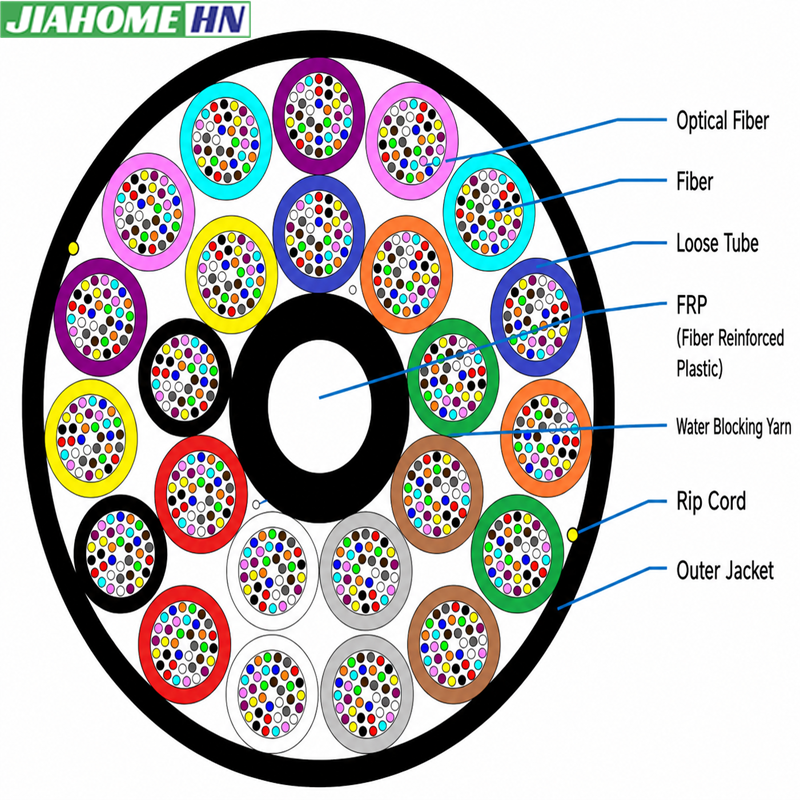
48 Cores -1728 Cores High-density Air-blow Micro-cable
Product Description
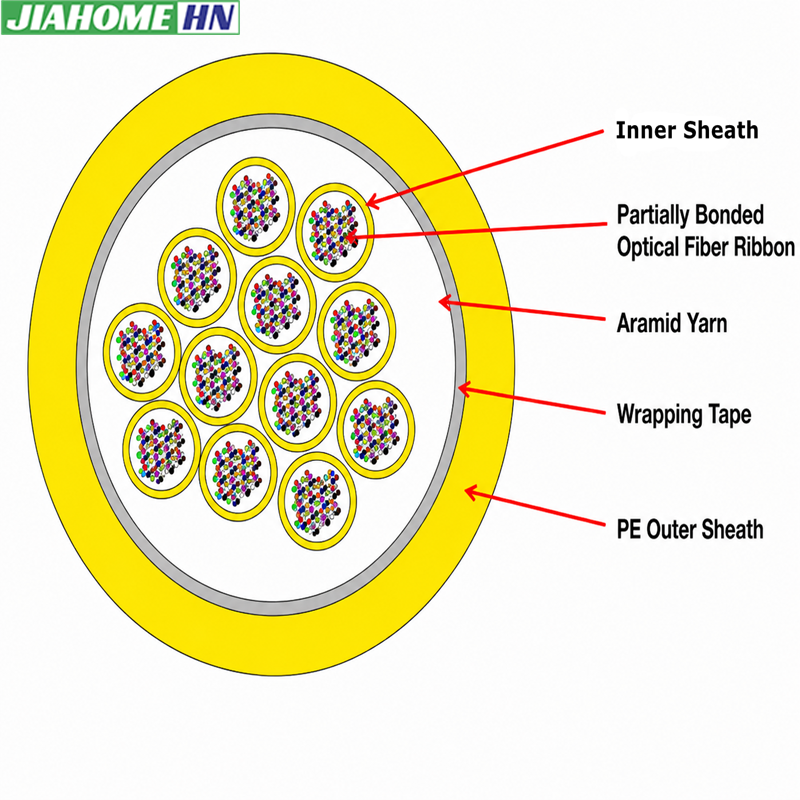
Outdoor High-Density Air-Blown Fiber Optic Cable is designed for high-capacity backbone transmission and future network expansion requirements. By combining ultra-high fiber density with air-blown installation technology, the cable significantly reduces duct occupancy while improving deployment efficiency and scalability. It is especially suitable for outdoor duct networks and high-capacity data center interconnection projects.
The cable adopts a thin-wall airflow channel outer jacket design, which optimizes airflow efficiency and reduces friction during installation, allowing long-distance and high-speed air-blown deployment
Product Features
Ultra-High Fiber Density Design
The compact structure supports 48-core to 1728-core configurations, maximizing fiber capacity within limited duct space. Compared with conventional loose tube outdoor cables, the high-density design reduces duct utilization costs and allows more efficient network resource allocation.
Advantages:
- Higher fiber count within smaller cable diameters
- Reduced duct occupancy
- Lower civil construction costs
- Suitable for future network expansion
Optimized Air-Blown Installation Performance
The specially designed airflow-channel outer sheath minimizes cable-to-duct friction and improves airflow transmission efficiency.
Performance Benefits:
- Air blowing speed up to 100 m/min
- Reduced installation labor and time
- Supports long-distance deployment
- Lower risk of cable damage during installation
Flexible Fiber Selection
Different fiber diameters can be selected according to project requirements:
250μm Fiber
- Standard solution
- Higher mechanical protection
- Suitable for conventional outdoor networks
200μm Fiber
- Balanced density and performance
- Increased fiber packing efficiency
180μm Fiber
- Maximum fiber density
- Ideal for ultra-high capacity projects
All options use G.657A1 bend-insensitive optical fibers, providing:
- Improved bending resistance
- Lower attenuation in compact installations
- Better performance in complex routing environments
Applications
Outdoor Duct Network Deployment
Recommended installation method:
- Installed with silicon-core ducts (HDPE silicon duct)
- Combined with professional air-blowing equipment
Suitable scenarios include:
- Metropolitan area networks (MAN)
- FTTH backbone infrastructure
- Campus networks
- Long-distance backbone routes
- Telecom operator duct systems
Benefits:
- Faster installation
- Reduced excavation requirements
- Easy future capacity upgrades
Data Center Interconnection
High-density air-blown cables are ideal for modern data center expansion projects, particularly:
- Building-to-building connectivity
- Outdoor campus interconnection
- Outdoor network access links
Recommended fiber count for data centers:
288F–1728F
Reasons:
- Supports high-density switch architectures
- Meets increasing bandwidth demands
- Allows future migration to higher transmission rates
- Simplifies network scalability planning
Key Benefits for EPC
Key Benefits for EPC and International Tender Projects
- High fiber density reduces total duct requirements
- Faster deployment lowers installation costs
- Supports future network expansion without additional civil works
- Flexible fiber options for different project specifications
- Optimized for large-scale infrastructure and hyperscale data center applications
- Suitable for telecom operators, EPC contractors, and data center developers
Outdoor high-density air-blown optical cable provides a scalable and cost-efficient solution for networks that require high capacity, rapid deployment, and long-term expansion capability.
FAQ
1. What is an outdoor high-density air-blown fiber optic cable?
An outdoor high-density air-blown fiber optic cable is a compact optical cable designed for duct installation using compressed air technology, allowing high fiber counts within a smaller cable diameter while improving deployment efficiency.
2. Why use air-blown fiber optic cables instead of conventional outdoor cables?
Air-blown cables reduce installation time, minimize duct space usage, lower civil construction costs, and provide easier future network expansion compared with traditional pulling methods.
3. What is the maximum blowing speed of this cable?
The cable supports air-blown installation speeds of up to 100 m/min, depending on duct conditions, route complexity, air pressure, and installation equipment.
4. Why is G.657A1 fiber used in this cable?
G.657A1 bend-insensitive fiber offers improved flexibility and lower bending loss, making it suitable for dense cable structures and complex routing environments.
5. Which fiber diameter option should I choose: 250μm, 200μm, or 180μm?
- 250μm: Better mechanical protection and standard applications
- 200μm: Balanced density and performance
- 180μm: Maximum fiber density for ultra-high-capacity networks
The selection depends on project capacity requirements and installation conditions.
6. What fiber count is recommended for data center applications?
For building-to-building interconnection and outdoor data center access networks, 288F–1728F is commonly recommended to support future bandwidth growth and high-density network architectures.
7. Can this cable be installed in existing ducts?
Yes. The compact high-density design and air-blown installation technology make it suitable for both newly constructed and existing duct infrastructure.
8. Is the cable suitable for long-distance outdoor deployment?
Yes. The optimized ultra-thin airflow channel outer jacket reduces friction during installation, enabling efficient long-distance deployment.
9. What type of ducts should be used with air-blown fiber cables?
The cable is typically installed with HDPE silicon-core ducts (silicon ducts) and professional air-blowing equipment for optimal installation performance.
HOT-SALE PRODUCT
Outdoor optical cable, indoor optical cable, indoor armored optical cable, air-blown optical cable, OPGW, optical jumper, etc.